
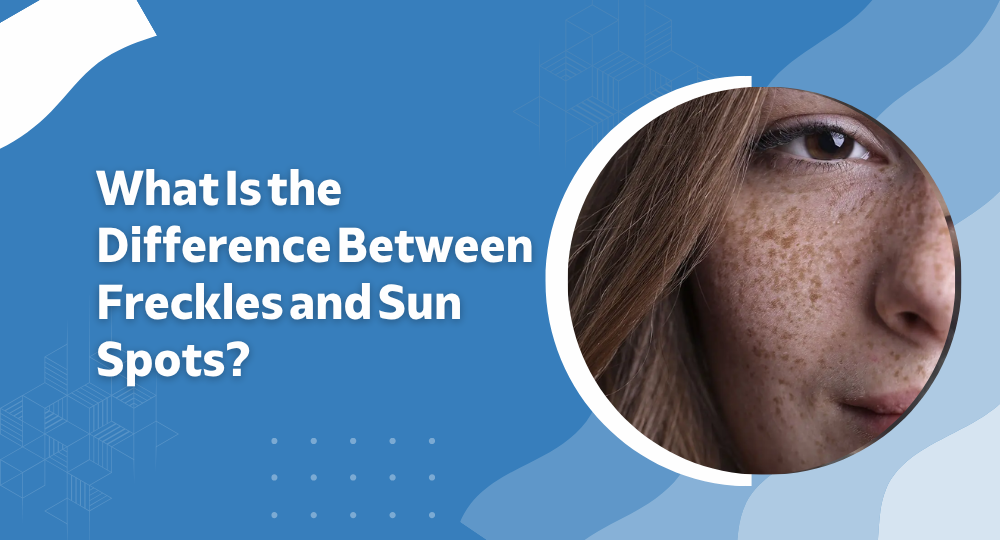
Freckles and sun spots both show up as flat brown marks,but that’s roughly where the similarity ends. Freckles are hereditary. They tend to darken through summer and fade back in winter, following UV exposure rather than accumulating from it. Sun spots work differently. They’re the result of years of UV damage building up in the skin, and unlike freckles, they don’t fade when the season changes. A skin specialist in Faridabad can tell them apart on examination, which matters because the treatment approach for each is different.
According to Dr. Archit Aggarwal, a skin specialist in Faridabad at KDC Skin & Hair Clinic, “Patients often come in thinking they have freckles when they’re actually looking at sun spots that have been building for years. The distinction matters clinically because one responds to sun protection alone and the other usually doesn’t.”
Freckles vs Sun Spots: A Direct Comparison?
|
Feature |
Freckles |
Sun Spots |
|
Cause |
Genetic, UV triggers them |
Cumulative UV damage over years |
|
Age of onset |
Childhood, early teens |
Typically 30s and beyond |
|
Seasonal change |
Darken in summer, fade in winter |
Permanent, no seasonal shift |
|
Colour |
Light to medium brown |
Darker brown, sometimes grey |
|
Skin type |
Common in fair skin, light hair |
Any skin type, including Indian skin |
|
Location |
Face, shoulders, arms |
Face, hands, chest, forearms |
|
Treatment needed |
Often none |
Usually requires active treatment |
|
Fade on their own |
Yes, partially in winter |
No |
Freckles in childhood are almost always benign and need no intervention. Sun spots that appear on hands or face after 35 deserve a proper check, especially if any are changing shape or colour. A quick look at pigmentation treatment in Faridabad covers what treatment options are available for persistent marks.
How Are Freckles and Sun Spots Treated Differently?
Treatment depends on what’s actually there.Getting this wrong either does nothing or causes unnecessary irritation.
Freckles, no treatment: If they’re stable, symmetrical, and fading each winter, leaving them alone is usually the right call. Broad-spectrum SPF 50 every morning slows the darkening.
Freckles, cosmetic concern: Topical agents like azelaic acid or kojic acid lighten them gradually. Chemical peels work faster for patients who want visible change within a few months.
Sun spots, SPF alone isn’t enough: Once UV damage is locked into the skin, sunscreen maintains the result but doesn’t reverse what’s already there.
Sun spots, active treatment: Laser toning, chemical peels, and prescription depigmenting agents (hydroquinone, tretinoin combinations) are the standard approaches. Laser works faster on well-defined spots.
When biopsy is needed: Any pigmented patch that’s asymmetric, has irregular borders, or is growing should be examined properly before any cosmetic treatment is started.
A related point worth knowing: how healing skin reacts to sun exposure after any pigmentation treatment follows the same rules covered in the earlier post on mole removal treatment. Skipping sunscreen after any procedure darkens the result.
Why Choose Dr. Archit Aggarwal for Pigmentation Treatment?
Dr. Archit Aggarwal is an MD Dermatologist from RGUHS Bangalore with 13+ years performing minor skin surgeries on Indian skin. Every facial mole at KDC is examined with a dermatoscope first, biopsied if suspicious, and removed using the technique that leaves the least scarring. No shortcuts, no cautery burns, no parlour-style butchery.
KDC Skin & Hair Clinic handles hundreds of mole removal cases each year with strict sterile protocols and visible results.
Frequently Asked Questions
Can freckles turn into sun spots over time?
Freckles don’t convert into sun spots, but years of sun exposure can cause both to appear on the same skin simultaneously, making them harder to separate.
At what age do sun spots usually appear?
Most people start noticing them in their mid-thirties. On Indian skin, they often appear a decade later than on fairer complexions.
Does sunscreen remove existing sun spots?
No. Sunscreen stops new damage but doesn’t reverse what’s already pigmented. Active treatment is needed for existing spots.
Are freckles a sign of skin cancer risk?
Freckles themselves aren’t cancerous. Fair-skinned individuals who freckle easily do have higher UV sensitivity, which is a risk factor worth knowing.
Disclaimer: This blog is for educational purposes only and is not a substitute for professional medical advice.