

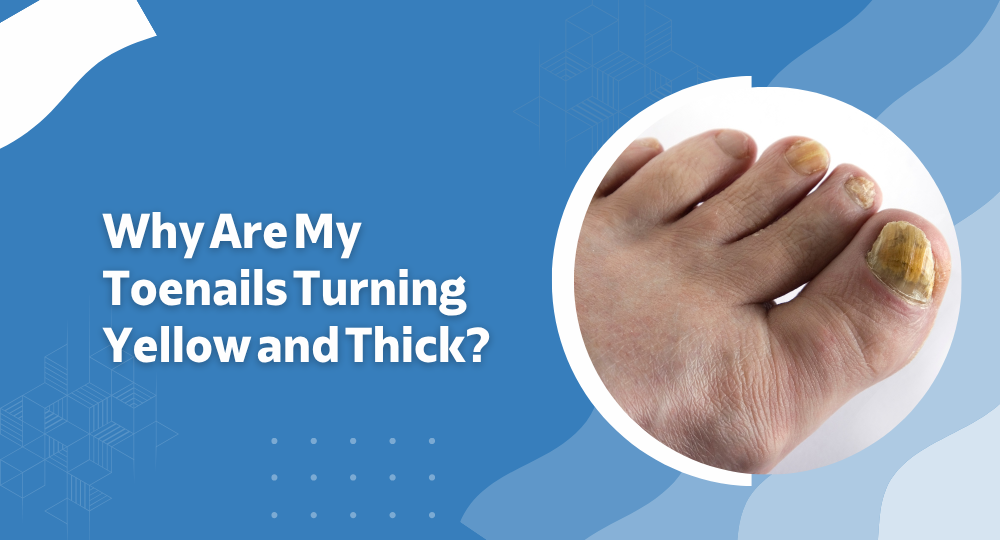
Yellow discolouration with thickening of a toenail is something most people attribute to fungus without much thought. That assumption holds up often enough, but it misses a fair number of cases. Nail psoriasis produces the same visual changes. So does prolonged mechanical pressure from footwear. Systemic conditions including diabetes and thyroid dysfunction can alter nail structure from within, with no infection present.
According to Dr. Archit Aggarwal, a skin specialist in Faridabad at KDC Skin & Hair Clinic, “Yellow thickened nails get self-treated for months before patients come in. By then the infection has usually spread to other nails. Early diagnosis changes the treatment timeline significantly.”
What Causes Yellow and Thick Toenails?
Four things commonly produce this presentation, and each requires a different response.
Fungal infection: Dermatophytes penetrate through small skin breaks near the nail bed, causing progressive yellowing, thickening, and eventual crumbling at the nail tip.
Nail psoriasis: Identified by pitting across the nail surface and an oil drop discolouration beneath it. Frequently misread as fungal infection despite being an entirely different condition.
Pressure thickening: Tight footwear pressing on the same nail repeatedly over months produces gradual thickening with no infection involved whatsoever.
Systemic disease: Diabetes, thyroid disorders, and circulatory problems affect nail quality from within the body, not through any external pathogen.
A KOH examination or laboratory analysis of a nail clipping distinguishes fungal infection from other causes. This is the starting point for nail disease treatment in Faridabad at KDC, before any prescription is written.
Toenails changing colour or texture? Book Appointment
How Is Toenail Fungus Treated?
The density and slow growth rate of toenails limits what surface applied treatments can achieve against an established infection.
Oral antifungals: Terbinafine or itraconazole taken over a defined course following confirmed diagnosis, with liver function assessed beforehand in relevant patients.
Topical lacquer: Amorolfine or ciclopirox applied directly to the nail for early stage infections that have not yet involved the nail matrix, though resolution takes longer than with oral therapy.
Laser treatment: Directed into the nail plate to target the fungus when oral antifungals are medically unsuitable for the patient.
Nail avulsion: Surgical removal under local anaesthesia for nails beyond the point of medical recovery, followed by natural regrowth from the matrix over several months.
Periungual skin discolouration sometimes accompanies nail fungal infection and gets read incorrectly as an unrelated pigmentation issue. The post on freckles vs sun spots explains how to read skin pigmentation changes more accurately when that overlap occurs.
Why Choose Dr. Archit Aggarwal for Nail Treatment in Faridabad?
Dr. Archit Aggarwal is an MD Dermatologist from RGUHS Bangalore with 13+ years in clinical practice. Nail presentations at KDC are investigated before treatment is decided, not after. Fungal infection, psoriasis, and mechanical thickening share enough surface features to be confused for one another routinely. Prescribing without confirming the cause accounts for most of the treatment failures patients describe when they arrive at the clinic.
KDC Skin & Hair Clinic treats nail presentations with confirmatory testing before any prescription, using the diagnostic route that separates fungal infection from its look-alikes. Call +91 86868 63140 to book an assessment.
Frequently Asked Questions
Can yellow toenails clear without treatment?
Fungal onychomycosis does not resolve on its own. Without treatment it progresses, usually involving adjacent nails over time. Mechanical thickening from footwear is a separate matter and may improve with better fitting shoes, but that distinction matters before deciding not to treat.
How long does treatment take?
Oral antifungal courses typically run three to six months depending on infection severity. Nail plate regrowth adds further time to achieving a visibly clear result, often extending the process to around a year.
Is toenail fungus contagious?
Transmission occurs through direct skin contact and via contaminated surfaces such as shared footwear, gym floors, and swimming areas. Early treatment contains the infection before it spreads to other nails or to other members of the household.
Should nail polish be avoided during treatment?
Nail polish occludes the nail surface and retains moisture beneath it, creating conditions that support fungal persistence. It also prevents visual monitoring of treatment response, which matters clinically across a multi-month course.
Disclaimer: This blog is for educational purposes only and is not a substitute for professional medical advice.
